
Search Bond County Tax Records
Bond County property tax records are kept by the treasurer and supervisor of assessments in Greenville. This small county in south-central Illinois has about 16,700 residents and covers a mix of farmland and small towns along Interstate 70. You can look up tax bills, check assessed values, and review payment history for any parcel through the county's online portal or by visiting the courthouse. The treasurer collects all taxes, while the assessor's office sets the property values that determine each year's bill.
Bond County Property Tax Quick Facts
Online Tax Search Portal
The best way to search Bond County property tax records is through the Bond County tax search portal. You can look up any parcel by owner name, address, or parcel number. The results show the tax bill, assessed value, exemptions, and payment history. It is free to use and does not need an account.
Each result breaks the bill down by taxing district. You see what goes to the school district, fire protection, library, road fund, and other local bodies. This makes it easy to understand where your tax dollars end up. Bond County property tax records on the portal go back several years.
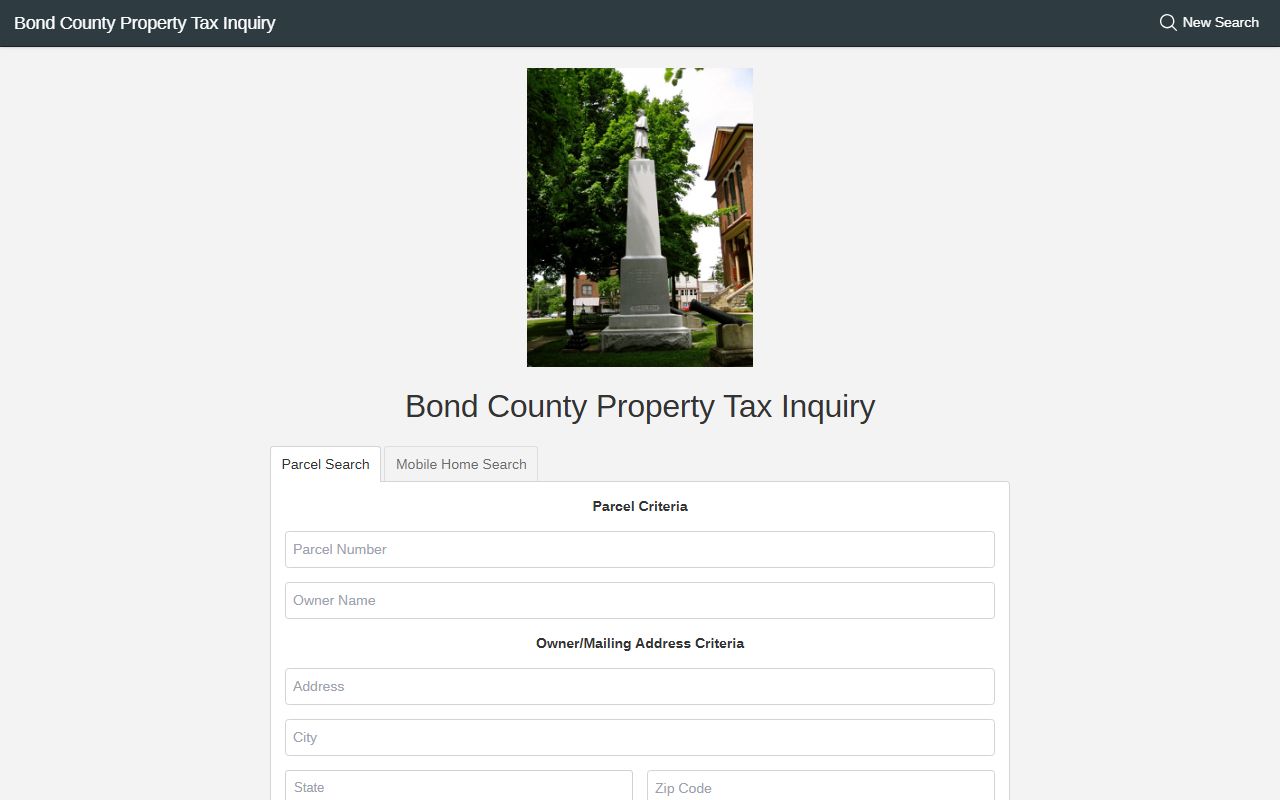
The search tool gives you a full picture of any parcel's tax history in Bond County. You can print or save results directly from the page if you need a copy for your own records.
Bond County Treasurer
The Bond County Treasurer handles all property tax collection. The office is in the Bond County Courthouse at 200 West College Avenue, Greenville, IL 62246. Call (618) 664-0449 for questions about bills or payments. Hours are Monday through Friday during regular business hours.
You can pay in person at the courthouse, by mail, or online. When paying by mail, include the stub from your tax bill and make checks payable to the Bond County Treasurer. The office also runs tax sale proceedings for parcels with unpaid taxes. Under 35 ILCS 200, delinquent taxes accrue interest at 1.5% per month. Eventually, the county sells those taxes to investors. The owner then gets a redemption period, usually two to three years, to pay back everything owed plus interest and fees.
Property Assessments
Property in Bond County is assessed at 33.33% of fair market value. That is the state standard for all counties outside Cook County. So a home worth $150,000 on the market would carry an assessed value of about $50,000. The Illinois Department of Revenue then applies an equalization multiplier to bring local values in line with the statutory level.
The Bond County Supervisor of Assessments oversees this process. Township assessors set the initial values, and the supervisor reviews them for accuracy. The office is at the courthouse in Greenville. Call if you have questions about how your value was determined or if you believe the number is wrong.
Exemptions reduce the assessed value after equalization. The general homestead exemption cuts up to $6,000 for owner-occupied homes. Seniors age 65 or older can get an added $8,000 senior homestead exemption. The senior freeze locks the EAV for qualifying low-income seniors. A disabled persons exemption of $2,000 is also available. These all appear on the Bond County property tax record for each parcel once approved.
Payment Schedule and Late Fees
Bond County property taxes are split into two installments each year. The first is due in the summer and the second in the fall. Exact dates vary, so check your bill or call the treasurer. Taxes are paid in arrears. The bill you get in 2026 is for the 2025 tax year.
Late payments get hit with interest right away. The state rate is 1.5% per month on whatever is unpaid. Missing both installments puts the parcel on the delinquent list. The county then sells the back taxes at its annual tax sale. Buyers pay the owed amount and earn interest when the owner redeems. The redemption period runs two to three years depending on the property. Every step in this process becomes part of Bond County property tax records for that parcel.
Appeals Process
Think your Bond County property is assessed too high? You have the right to appeal. Start at the Supervisor of Assessments office in Greenville. They can explain deadlines and what proof you need. Comparable sales data is the most common evidence. You can also bring an independent appraisal.
The Bond County Board of Review hears local appeals first. If you disagree with their ruling, take it to the Illinois Property Tax Appeal Board. PTAB is a state body that handles cases from every county. A successful appeal lowers your assessed value and cuts your bill going forward. The appeal record stays attached to the property's tax file.
County Clerk and Tax Extension
The Bond County Clerk plays a central role in setting tax bills. After assessments are equalized, the clerk takes levy requests from each taxing district and applies them to the total assessed value. School boards, fire districts, park districts, and road districts all send their levy amounts. The clerk figures out each rate and extends it across the parcels in that district.
Bond County has a number of overlapping taxing districts. Each one sets its own levy, and the clerk's office combines them into the total rate that shows on your bill. The Illinois Department of Revenue provides state-level oversight of equalization, but the actual calculation work happens at the county level. Contact the clerk in Greenville if a rate on your bill seems off.
Additional Property Records
Tax bills are just one piece. Bond County keeps other property records through the recorder's office. Deeds, mortgages, liens, and easements are all on file. These tie into tax records because they track who owns what. When a property changes hands, the recorder files the new deed and the assessor updates the owner.
The Illinois Property Tax Public Inquiry site can also help. It pulls data from counties across the state. For Bond County, though, the local portal gives you the freshest data. The Illinois Property Tax Code lays out the full set of rules that govern assessment, collection, and sales statewide.
Nearby Counties
Properties near a county line may be in a neighboring county. Always confirm which county your land falls in before searching tax records.