
Find DeKalb County Property Tax Records
DeKalb County property tax records are maintained by the treasurer, assessor, and county clerk in Sycamore. The county has around 100,703 residents and covers a mix of farmland and growing suburbs west of the Chicago metro area. You can search current and past tax bills, assessed values, payment status, and exemption details for any property in DeKalb County using the online search tool. The treasurer's office in Sycamore processes all tax payments, and the supervisor of assessments sets the values that form the base for each year's bill.
DeKalb County Property Tax Quick Facts
DeKalb County Property Tax Search Portal
The best place to look up DeKalb County property tax records is the DeKalb County tax search portal. You can search by owner name, address, or parcel number. The results show the full tax bill, assessed value, and payment history. The tool is free to use and does not need a login.
The DeKalb County tax search portal provides quick access to tax bill details and payment history for any parcel in the county.
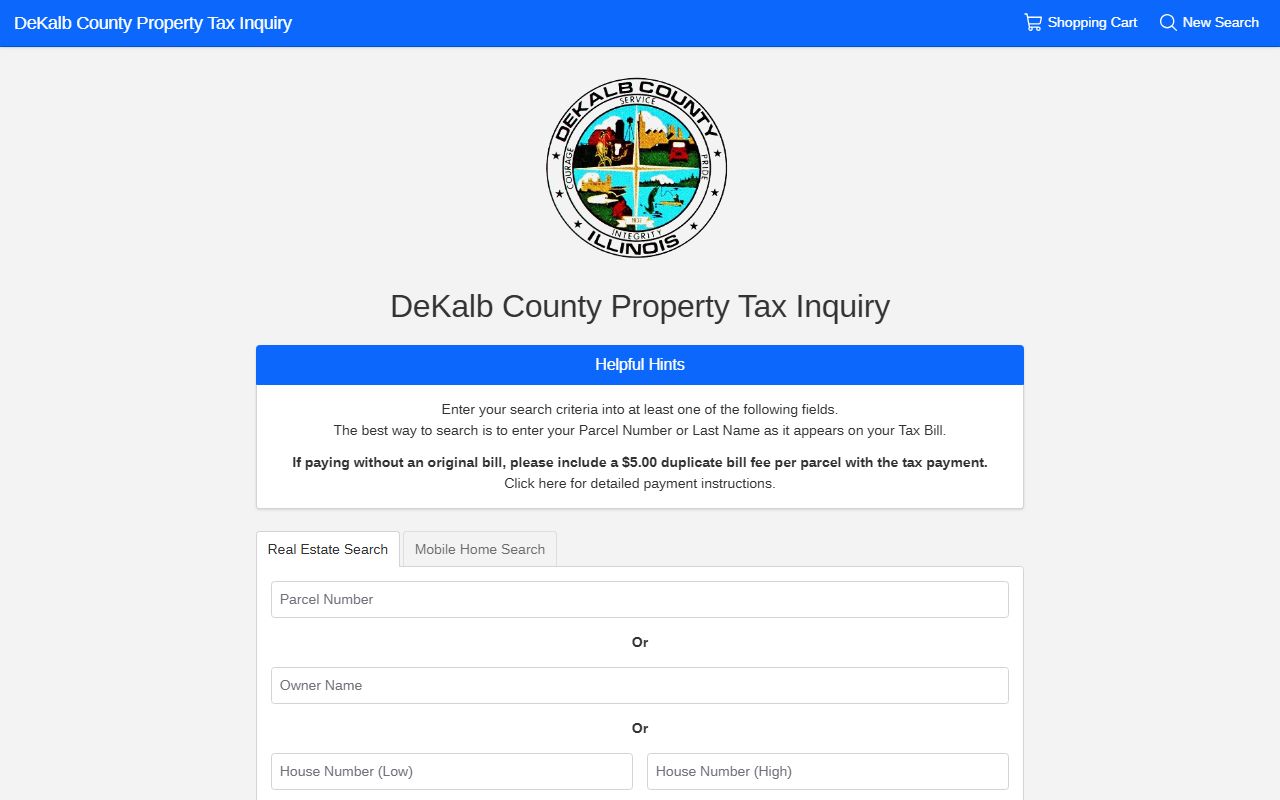
When you pull up a property, you get a breakdown of every taxing district on the bill. School districts, park districts, fire protection, library, and township levies all show up line by line. This makes it easy to see where your tax dollars go in DeKalb County. You can also view prior year bills to track how your taxes have changed over time.
DeKalb County Treasurer
The DeKalb County Treasurer collects property taxes for the entire county. The office is at 110 E Sycamore St, Sycamore, IL 60178. Call (815) 895-7133 for help with bills or payments. The treasurer sends out tax bills and processes payments by mail, in person, and online.
Property taxes in DeKalb County are paid in two installments each year. The first installment is typically due in June and the second in September, though exact dates vary. Under 35 ILCS 200, taxes are billed one year behind. So your 2024 tax bill shows up in 2025. If you miss a payment, statutory interest of 1.5% per month kicks in right away. That cost builds with each month the bill stays unpaid.
The DeKalb County government website has links to the treasurer and other offices. It is a good starting point if you need contact info or want to learn about payment options.
Property Assessments in DeKalb County
The DeKalb County Supervisor of Assessments sets property values. Call (815) 895-7127 for questions about your assessment. The office reviews values each year and adjusts them based on sales data and market conditions.
DeKalb County follows the standard Illinois assessment model. All property is assessed at 33.33% of fair market value. A home worth $240,000 on the market would have an assessed value near $80,000. The Illinois Department of Revenue then applies an equalization factor to make sure values are uniform across the state. Your tax bill is based on the equalized assessed value after any exemptions are subtracted. This process is governed by 35 ILCS 200 and works the same way in every Illinois county except Cook.
Farm land in DeKalb County is assessed differently. Illinois uses a soil productivity formula for agricultural property, which often results in lower assessed values than residential or commercial land. If you own farm ground in DeKalb County, the assessor uses soil type and crop yield data to set the value rather than looking at comparable sales.
Tax Exemptions in DeKalb County
Several exemptions can lower your DeKalb County property tax bill. The most common ones are listed here:
- General homestead exemption: up to $6,000 off your EAV
- Senior homestead exemption (age 65+): up to $8,000 off EAV
- Senior freeze: locks your EAV if household income is below the limit
- Disabled persons exemption: $2,000 off EAV
- Disabled veterans exemption: varies based on disability rating
You apply for these through the assessor's office. Once approved, the exemption shows up on your property tax record and reduces your bill each year. Some exemptions need to be renewed annually while others stay in place until you sell the home or your situation changes.
County Clerk and Tax Rates
The DeKalb County Clerk is at (815) 895-7147. The clerk handles the tax extension process, which is where levy requests from taxing districts get turned into actual tax rates. Each year, school boards, cities, park districts, and other local bodies submit their levy amounts to the clerk. The clerk divides each levy by the total EAV in that district to come up with a rate. That rate gets applied to your property's EAV to produce your tax bill.
DeKalb County has a large number of taxing districts. Northern Illinois University sits in the county, which adds its own dynamic to local tax policy. Areas around DeKalb and Sycamore tend to have higher rates because of more overlapping districts. Rural parts of the county may see lower rates. Every property in the county has a unique combination of districts on its bill, and the clerk's office puts it all together.
Delinquent Taxes and Tax Sales
If DeKalb County property taxes go unpaid, the county holds an annual tax sale. Investors can bid on the right to pay back taxes on delinquent parcels. Under 35 ILCS 200, the property owner gets a redemption period of two to three years to pay back what is owed plus interest. Interest on tax sale certificates is steep. It can run as high as 18% every six months depending on the bidding.
Tax sale records are public. You can check whether a property has gone through a tax sale or has outstanding delinquent taxes. This is good to know before buying property in DeKalb County. Unpaid taxes follow the land, not the person, so a new owner can inherit the problem if they do not check first.
Cities in DeKalb County
DeKalb County includes the cities of DeKalb, Sycamore, Genoa, and Sandwich, among others. None of these cities has a population over 50,000. All property tax records for cities in DeKalb County are handled by the county treasurer and assessor in Sycamore.
Nearby Counties
These counties border DeKalb County. If your property is near a county line, confirm which county it falls in before searching. Property tax records are stored by the county where the property sits.