
De Witt County Property Tax Records
De Witt County property tax records are available through the county treasurer's office in Clinton. Located in central Illinois between Bloomington and Decatur, De Witt County has about 15,400 residents. The county is primarily agricultural, with Clinton serving as the main center for government and commerce. The treasurer collects all property taxes, and the supervisor of assessments oversees valuations across the county. You can search tax bills, check assessed values, and review payment history using the online portal or by visiting the courthouse in Clinton.
De Witt County Property Tax Quick Facts
Online Tax Search Portal
The De Witt County tax search portal lets you look up property tax records for any parcel. Search by owner name, property address, or parcel number. Results show tax bill details, assessed value, exemptions, and payment history. The portal is free and does not require an account.
Each result breaks down the bill by taxing district. Schools, fire protection, road districts, park districts, and townships all get their own line. De Witt County is not large, but there are still enough overlapping districts to create rate differences across the county. The portal keeps records from past years too. This makes it easy to compare your bill from one year to the next and see how assessed values have shifted. You can print or save any record right from the browser.
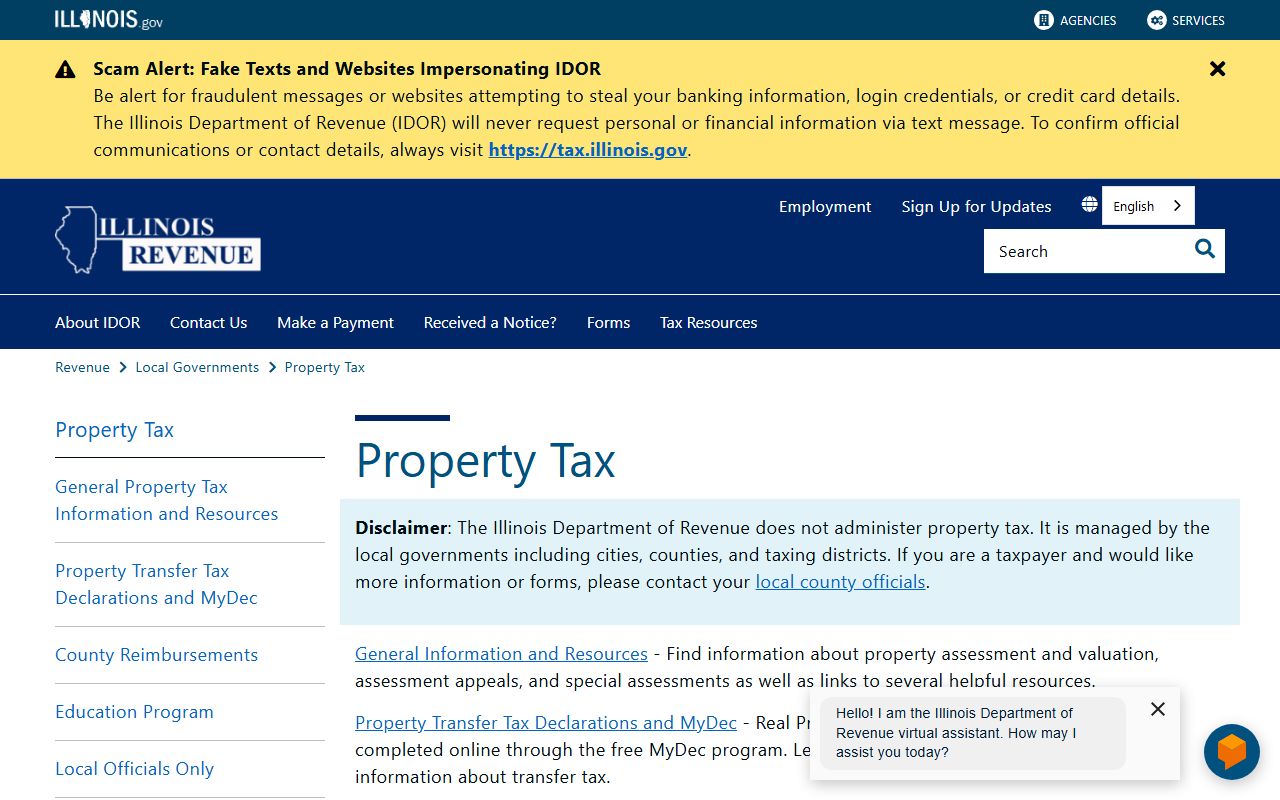
For statewide data, check the Illinois Property Tax Public Inquiry site. The local De Witt County portal is usually more current for county-specific lookups.
De Witt County Treasurer
The De Witt County Treasurer handles all tax collection. The office is at the De Witt County Courthouse in Clinton, IL 61727. Call for help with your bill, to check on a payment, or to ask about due dates. Hours are Monday through Friday during regular business hours.
Pay in person at the courthouse, by mail, or online. Mail payments should include the stub from your bill and a check payable to the De Witt County Treasurer. The treasurer also manages the annual tax sale for delinquent properties. Per the Illinois Property Tax Code (35 ILCS 200), late taxes draw a 1.5% monthly penalty. When taxes stay unpaid long enough, the county auctions them off. Investors pay the back amount and earn interest when the owner redeems. The redemption period is usually two to three years. If the owner doesn't redeem, the buyer can petition for a tax deed.
Clinton Lake, a popular recreation area in the county, brings some seasonal property interest. But the tax process is the same for all parcels. Whether it is lakefront or farmland, taxes run through the treasurer's office in Clinton.
Property Assessments
De Witt County property is assessed at 33.33% of fair market value. That is the statewide standard outside Cook County. A home valued at $140,000 would carry an assessed value of about $46,660. Township assessors do the initial work, and the De Witt County Supervisor of Assessments reviews everything for accuracy and uniformity.
The Illinois Department of Revenue applies an equalization multiplier each year to align local values with the 33.33% target. The equalized assessed value (EAV) is what tax rates get applied to. Farmland follows a different track. Agricultural land in De Witt County is valued based on soil productivity rather than market price. Given the county's heavy agricultural base, a significant number of parcels are assessed this way. Questions about your value should go to the assessor's office in Clinton.
Exemptions
Exemptions lower your EAV and reduce your bill. Apply through the supervisor of assessments in Clinton.
Owner-occupied homes can get the general homestead exemption, which removes up to $6,000 from EAV. Seniors 65 and older are eligible for an additional $8,000 via the senior homestead exemption. The senior freeze keeps EAV from rising for qualifying low-income seniors. Disabled persons can claim a $2,000 reduction. Disabled veterans may qualify for significantly larger exemptions based on their disability level. Some exemptions need annual renewal, so stay on top of the filing requirements. Approved exemptions show up on the De Witt County property tax record.
Payment Schedule and Penalties
De Witt County property taxes come due in two installments. The first is in summer. The second is in fall. Exact dates change yearly, so check your bill. Taxes are paid in arrears. The 2026 bill is for the 2025 tax year.
Late payments get a 1.5% monthly penalty on the unpaid balance. That penalty starts right away and keeps compounding. Miss both installments and the parcel goes on the delinquent list. The county sells those unpaid taxes at its annual tax sale. Tax buyers pay the owed amount and collect interest when the owner redeems. Owners typically have two to three years to pay back everything owed. Failure to redeem can lead to loss of the property. These proceedings all appear in De Witt County property tax records.
Appeals
You can appeal your De Witt County assessment if you believe the value is too high. Start by contacting the Supervisor of Assessments in Clinton. They will tell you the deadline and what you need. Comparable sales data is the most common evidence used. You can also get an independent appraisal.
The De Witt County Board of Review hears local appeals. They review the facts and make a decision. If you disagree, the next step is the Illinois Property Tax Appeal Board (PTAB). PTAB handles cases from all 102 counties. A win reduces your EAV and lowers your future bills. The Illinois Department of Revenue has more details on the full appeals process.
County Clerk and Tax Rates
The De Witt County Clerk calculates tax rates after assessments are set. Each taxing district submits its levy. The clerk divides each levy by the total EAV in the district to figure the rate. Schools make up the biggest piece almost everywhere. Fire, road, township, library, and park levies add to the total.
Because taxing districts overlap differently across the county, rates vary by location. A parcel in one school district could face a noticeably different rate than one a few miles away. The clerk's office in Clinton can explain the rates on your specific bill if needed.
Communities in De Witt County
Clinton is the county seat and largest city. Other communities include Farmer City, Weldon, Wapella, and Kenney. None has its own tax office. All property tax matters go through the county offices in Clinton, and the online portal covers every parcel in De Witt County.
Nearby Counties
If your land sits near a county border, check which county holds the tax records before you search.